What Happens When You Put a Farm on a Houston Rooftop?
Andrew Whit on what an acre of living soil four stories above downtown Houston is teaching Blackwood: temperatures about 31 degrees cooler, about 75 percent less water, and killdeer nesting on the roof.
By Andrew Whit
On a summer afternoon in downtown Houston, a rooftop can become one of the hottest places in the city.
Concrete, roofing membranes, glass and steel absorb the sun throughout the day, holding onto heat and radiating it back into the surrounding environment. At their hottest, Houston rooftops can approach 170 degrees Fahrenheit.
But on top of POST Houston, something different is happening.
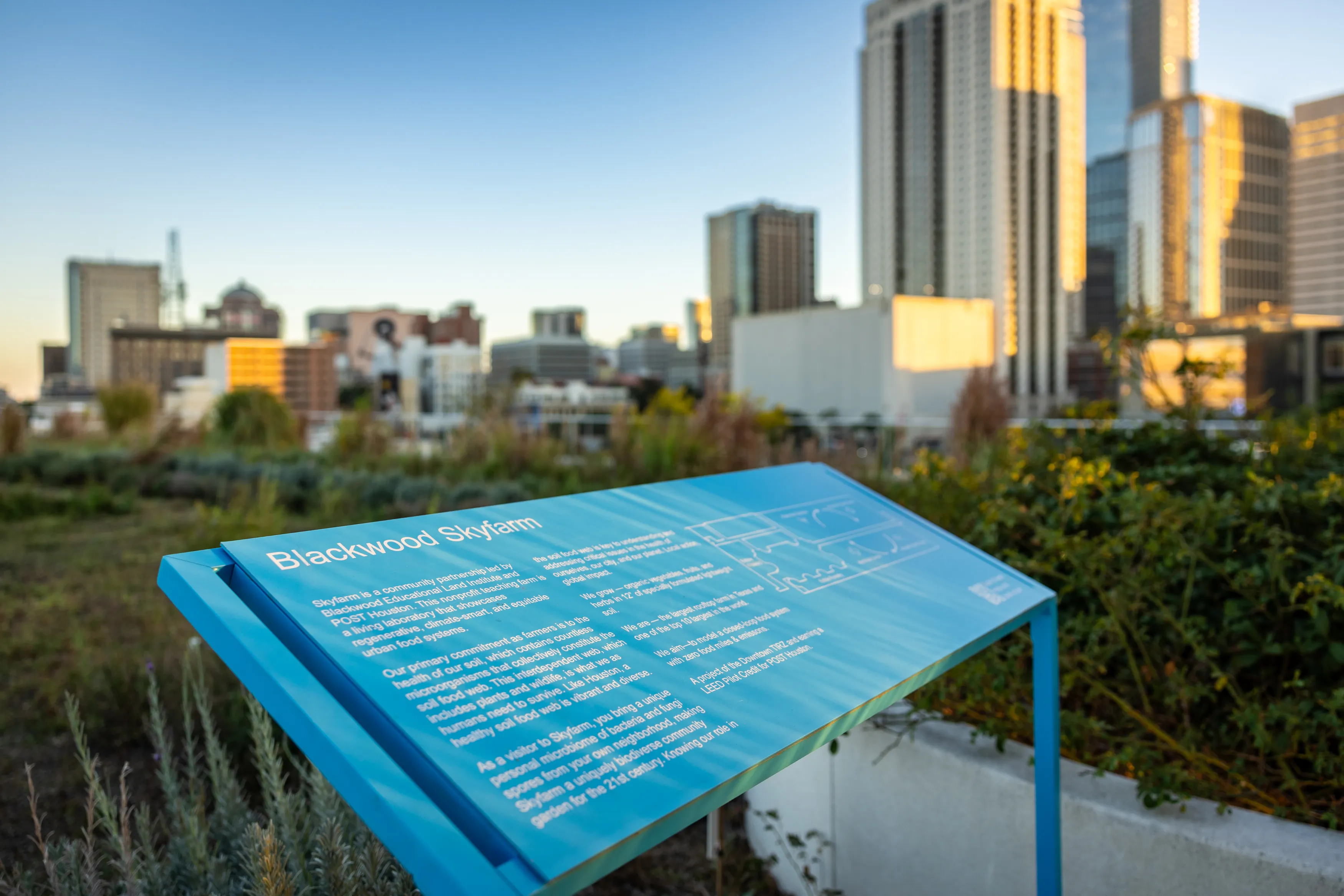
The Blackwood Skyfarm occupies roughly 1 acre of the building’s rooftop, where vegetables, herbs, flowers and cover crops have replaced what might otherwise be another expanse of heat-absorbing roof. Measurements at the Skyfarm have shown temperatures averaging about 31 degrees cooler than conventional Houston rooftops can reach.
That difference tells a bigger story than simply making one rooftop cooler. It offers a glimpse of what can happen when we begin treating underused urban surfaces as living landscapes.
Plants interact with heat very differently than conventional building materials. Vegetation shades surfaces that would otherwise be exposed directly to sunlight. Soil holds moisture. Plants move water from the soil into the atmosphere through evapotranspiration, creating a natural cooling effect.
At the Skyfarm, the rooftop is doing more than supporting food production. It is functioning as a living system in the middle of downtown Houston.
And “living” is increasingly literal.
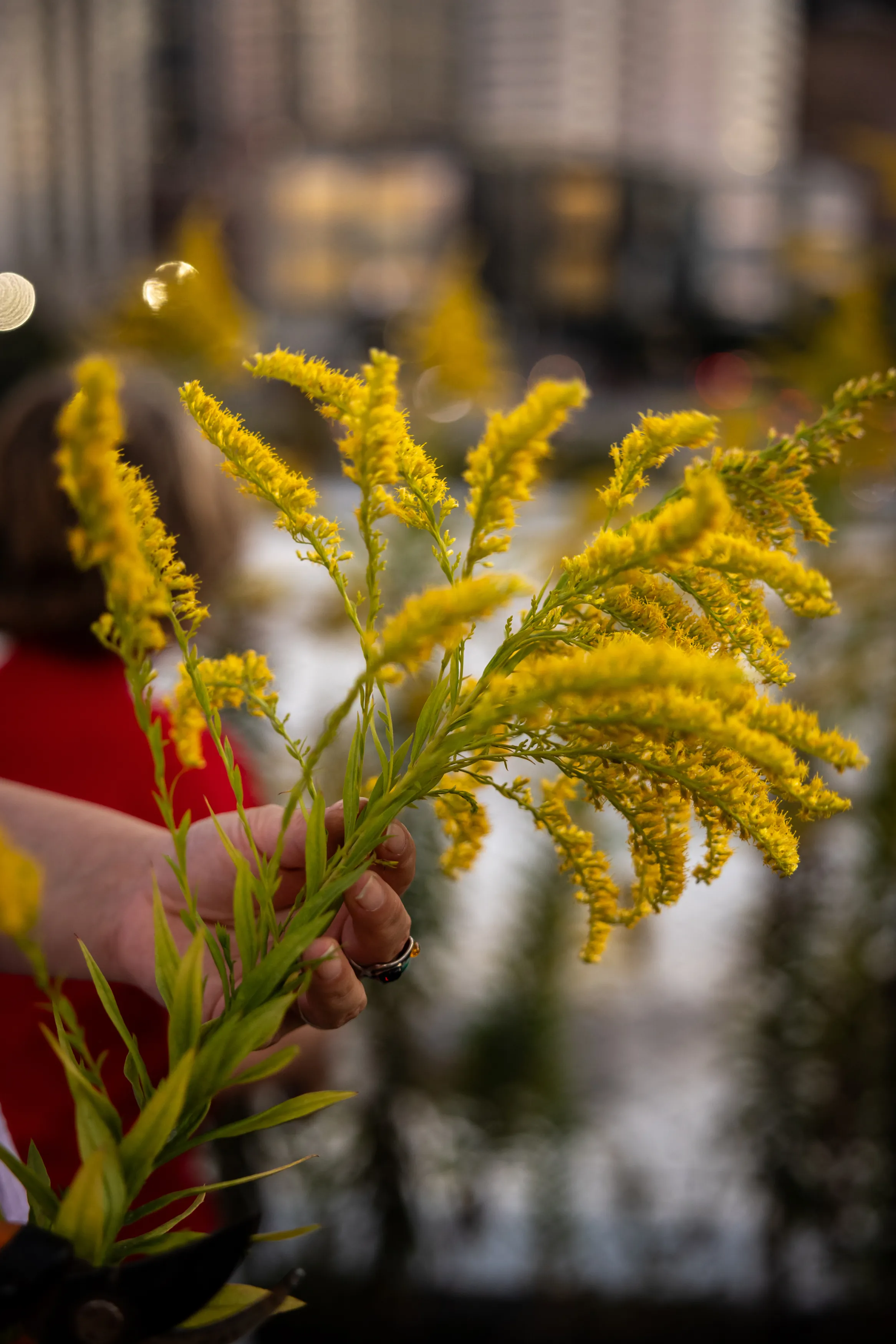
Flowering plants attract pollinators moving through the city. Birds visit the rooftop, finding food and space in an environment surrounded by dense urban development. For the past two years, killdeer have even chosen the Skyfarm as a place to lay their eggs.
There is something remarkable about that image: four stories above downtown Houston, wildlife is making use of an ecosystem that did not exist here before.
What happens above the soil, however, begins with what is happening inside it.
Blackwood’s work toward Regenified certification at our Landfarm in Hempstead has challenged us to look more closely at the relationships between soil, water, plants, insects, wildlife and the larger ecosystems surrounding our farms. While the Skyfarm is not a truly regenerative farm—a rooftop growing environment has inherent limitations that distinguish it from farming directly on the land—many principles of regenerative agriculture can still be applied there.
That has changed the way we manage the space.
Rather than treating soil simply as a medium for holding plants upright, we work to protect it as a living ecosystem. We minimize disturbance, protect microbial communities, keep living roots in the soil, use cover crops and maintain organic matter. We also think about what we plant beyond its value as a harvestable crop. A diverse landscape can provide food and habitat for insects and pollinators, which become part of a larger food web that includes the birds visiting the farm.
Those practices have changed the way the Skyfarm uses water, too.
Healthy, well-structured soil acts more like a sponge than a sieve. When water enters the system, the goal is not simply to keep plants alive until the next irrigation cycle. We want the soil to capture that moisture, hold onto it and make it available to plants over a longer period of time.
On a rooftop exposed to the full force of the Houston sun, that ability matters enormously.
And the results have been significant.
Over the past two years, as Blackwood has incorporated more regenerative practices into the Skyfarm, the farm has reduced its water use by approximately 75 percent.
For a productive farm sitting above a downtown building in one of the hottest major cities in the country, that reduction changes the way we think about what is possible in an urban growing space.
It can be tempting to look at the Skyfarm’s cooler temperatures, reduced water use and wildlife activity as separate successes. In reality, they are connected.
Better soil holds more water. More available moisture supports healthier plants. Healthy vegetation provides more consistent shade and evapotranspiration. Covered, living soil is protected from direct sunlight and loses less moisture to evaporation. Greater plant diversity creates more opportunities for pollinators, insects and birds to use the space.
Each improvement strengthens another.
That interconnectedness is one of the most important lessons Blackwood has taken from regenerative agriculture. A farm is not a collection of individual problems to solve. Soil health, water, temperature, biodiversity and plant productivity continually influence one another.
The Skyfarm makes those relationships unusually visible because the contrast is so immediate. Downtown Houston provides the backdrop: acres of concrete, pavement, glass and conventional rooftops surrounding a small patch of living soil.
Then, four stories above the city, there is a farm—one where crops grow, pollinators forage and birds have decided, quite literally, to make a nest.
The Skyfarm alone cannot solve Houston’s heat or restore all of the habitat lost to urban development. But that is not what makes it important.
Its value is in demonstrating, at a tangible scale, that the surfaces we build into our cities do not have to remain ecologically inactive.
A rooftop can become productive growing space. Thoughtful soil management can reduce irrigation demand. Vegetation can change the temperature of a surface that would otherwise absorb tremendous amounts of heat. And even in the middle of dense urban development, creating a diverse living landscape can provide resources for other species.
Every season gives us more information.
The Skyfarm has become a place where Blackwood can observe how agricultural practices behave under unusually demanding conditions. Houston gives us intense heat, heavy rainfall, drought and humidity—sometimes within remarkably short periods of one another. A rooftop adds another layer of exposure.
Yet within those conditions, we have watched soil improve, water use decline, plants thrive and wildlife return season after season.
If practices centered on soil health, biodiversity and water retention can make a measurable difference here, that knowledge can inform how we approach other urban growing spaces.
Our experience at the Skyfarm is helping shape the way Blackwood thinks about urban agriculture beyond POST Houston: not simply as a way to grow food inside the city, but as a form of living infrastructure that can contribute to healthier urban environments.
A farm can produce vegetables.
But it can also hold water, protect soil biology, feed pollinators, provide habitat and cool the surface beneath it.
And perhaps most importantly for Blackwood, it can teach us how natural systems might be incorporated into places we have traditionally designed without them.
Be a part of the regenerative movement
Reconnect with the land, grow real food, and be a part of restoring the earth in a tangible, meaningful way.